
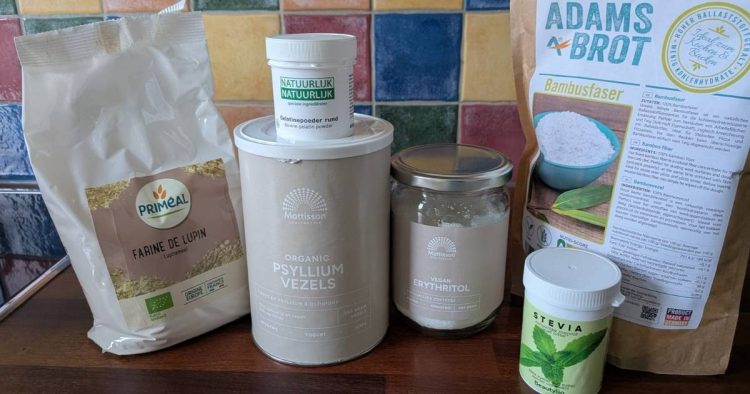
I’ll be honest with you: keto cooking has a shopping problem. Open almost any recipe on this blog and you’ll meet an ingredient your local Tesco has never heard of: allulose, lupin flour, xanthan gum, psyllium husk. I do realise the list can feel long, and that ordering a fresh pile of niche bits for every single recipe feels excessive. So I did the maths on my own blog to fix exactly that.
I went through every recipe on QueenKeto (all 428 of them) and counted how often each hard-to-find ingredient actually shows up. Then I worked out the smallest shopping list that unlocks the most cooking. The happy result:
Order these 16 ingredients once, and you can make roughly 80% of every recipe on this site. No more recipe-by-recipe scrambling. Just over a quarter of my recipes (28%) need nothing from a specialist shop at all. Stock the 16 below and 8 out of 10 of the rest open up to you.
Below I rank all 16 by how many recipes use them, most-used first, and explain what each one actually does in keto cooking, so you understand why it’s earning shelf space. Buy them in this order and you’ll feel the payoff almost immediately: the first six alone cover well over half the blog.
The grab-and-go keto pantry list
Short on time? Here’s the whole 80% pantry in one table. Skim the “what it does” column, grab what you don’t already have, and scroll down for the full story on each.
| Ingredient | What it does | Used in | Get it |
|---|---|---|---|
| 1. Stevia powder & liquid; a small tub + dropper |
Intense zero-carb sweetness in tiny pinches | 153 | Powder »Liquid » |
| 2. Erythritol 1 kg granulated |
The everyday bulk sweetener that measures like sugar | 116 | Buy » |
| 3. Lupin flour 500 g–1 kg |
My low-carb, high-protein backbone flour | 104 | Buy » |
| 4. Powdered / icing sweetener Sukrin/Swerve; 500 g or make your own |
Grit-free sweetness for icings, mousses & creams | 90 | Buy » |
| 5. Xanthan gum 100–250 g, lasts forever |
Replaces gluten’s stretch; binds & thickens | 64 | Buy » |
| 6. Allulose 1 kg |
Browns, softens & won’t crystallise: magic for ice cream & caramel | 43 | Buy » |
| 7. Whey protein isolate; unflavoured + a sweet flavour |
Structure, rise & chew in breads and cakes | 35 | Buy » |
| 8. Gelatine beef/unflavoured; 250 g |
Sets mousses, panna cotta, marshmallows, smoother ice cream | 28 | Buy » |
| 9. 100% baking chocolate 200–500 g |
The unsweetened base for all my chocolate work | 26 | Buy » |
| 10. Psyllium husk 250 g fine powder |
Gives keto bread its bend, chew & moisture | 25 | Fine »Coarse » |
| 11. Guar gum 100–250 g |
Xanthan’s partner or alternative; binds & smooths | 13 | Buy » |
| 12. Oat fibre 250–500 g |
Carb-free “flour volume” and dryness (not oat flour!) | 13 | Buy » |
| 13. Sugar-free fibre / allulose syrup 1 bottle |
The liquid sweetener for sticky, glossy, “golden-syrup” jobs | 13 | Buy » |
| 14. MCT oil 500 ml |
Flavourless fat for energy, coffee & soft-set treats | 11 | Buy » |
| 15. Cacao butter 250–500 g |
The fat that makes homemade chocolate set hard & glossy | 10 | Buy » |
| 16. Bamboo fibre 250 g |
Neutral carb-free fibre that lightens bakes | 9 | Buy » |
“Used in” = the number of my recipes that call for that ingredient. A recipe only becomes fully makeable once you own all of its specialist ingredients, which is why this ranked list is built to open up as many recipes as possible, as fast as possible.
Rather browse it all in one place? I’ve gathered these pantry staples in my QueenKeto Amazon storefront, so you can pick up everything you need in a single trip instead of hunting the links down one by one.
The 16, ranked: why each one earns its place
1. Stevia: used in 153 recipes (the workhorse sweetener)

If you only understand one thing about keto sweetening, make it this: stevia is intense. It’s a plant-derived sweetener many times sweeter than sugar, so recipes use it in pinches and drops, which is why a small tub lasts me an age. I rarely use it alone; it does its best work as a sweetness booster alongside a bulk sweetener like erythritol or allulose, lifting the sweetness without adding bulk or that tell-tale cooling tingle. Keep both forms in: pure powder for baking and a liquid for puddings, drinks and anything you don’t want to add powder to. A little too much turns bitter, so always start small.
2. Erythritol: used in 116 recipes (your everyday sugar stand-in)
Erythritol is the sweetener I reach for most when I need actual volume. It’s a sugar alcohol with almost no impact on blood sugar and roughly 70% of sugar’s sweetness, so it measures fairly close to sugar in a recipe and gives bakes that familiar bulk and crunch. Two things to know: it can give a slight cooling sensation, and it likes to recrystallise as things cool (lovely for a crackly meringue, less lovely in a soft caramel). That’s exactly why allulose (#6) exists in my cupboard too. In the EU and UK it’s an approved food additive and is generally well tolerated, though large amounts can upset some tummies, so as with any sugar alcohol, build up gradually.
3. Lupin flour: used in 104 recipes (the flour that does the heavy lifting)

Lupin flour is my low-carb baking backbone. Milled from sweet lupin beans, it’s very low in net carbs and high in protein and fibre, and it’s naturally gluten-free, which is why it turns up in my breads, pasta, pastry, crackers and pizza bases. It has a faintly beany note and no gluten of its own, so it nearly always works in a team with a binder (xanthan, guar or psyllium) to get structure. Start with my lupin bread rolls or lupin pasta and you’ll see why it’s in a quarter of everything I make.
4. Powdered / icing sweetener (Sukrin Icing, Swerve Confectioners): used in 90 recipes
This is simply a sweetener (usually erythritol, sometimes with allulose) ground to icing-sugar fineness. Why keep it separate from #2? Because texture matters: when you want a silky mousse, a smooth buttercream, a glossy glaze or a dusting that melts on the tongue, granular sweetener leaves grit and powdered doesn’t. You can absolutely make your own by blitzing erythritol, but a ready-made tub is the convenient option, and it shows up in a fifth of my recipes.
5. Xanthan gum: used in 64 recipes (the gluten replacer)
Take gluten out of baking and you lose the stretch and structure that hold things together, and xanthan gum quietly puts it back. A scant half-teaspoon stops keto cakes crumbling, gives dough a workable elasticity, and thickens sauces, dressings and ice-cream bases beautifully. Respect the small quantities: too much and your bake turns gummy or slippery. One little pot lasts months.
6. Allulose: used in 43 recipes (the texture magician)

Allulose is the one that makes people fall in love with keto desserts. It’s a “rare sugar” with about 70% of sugar’s sweetness and next-to-no impact on blood sugar, but its party trick is texture. Unlike erythritol it doesn’t recrystallise, it browns and caramelises like real sugar, and it keeps things soft and scoopable. That makes it my go-to for ice cream, caramel, chewy cookies and soft sweets. Good news for your shopping list: many of my recipes say “allulose or erythritol”, so the two are often interchangeable, so keep both and you can pick the texture you want.
7. Whey protein isolate: used in 35 recipes (structure & rise)
In gluten-free, grain-free baking, protein is structure. Whey protein isolate gives keto breads and cakes their rise, chew and golden browning, and it’s a big reason my loaves aren’t “stodgy, dense and flat”. Buy unflavoured for savoury bakes and breads, and keep a vanilla or chocolate flavour for sweet ones. See it at work in my protein bread loaf.
8. Gelatine (beef / unflavoured powder): used in 28 recipes (the setter)
Whenever something needs to wobble, hold a shape or turn silky, gelatine is the quiet hero. It sets mousses, panna cotta and jellies, makes keto marshmallows possible, and gives no-churn ice cream a smoother, less icy set. I use unflavoured beef gelatine powder; bloom it in cold liquid first, then warm to dissolve. (Powder, not leaves: leaves are easy to find in supermarkets, the bulk powder less so.)
9. 100% / unsweetened baking chocolate: used in 26 recipes
This is pure cocoa with no sugar at all: the blank canvas for keto chocolate work. Because you control the sweetening yourself, it’s the base for my fondants, brownies, truffles and homemade bars. Brands like Montezuma’s and Callebaut melt cleanly. It’s intense and bitter on its own, and that’s the point: you team it with a sweetener and often a little fat.
10. Psyllium husk: used in 25 recipes (the bread-maker)

Psyllium husk is soluble fibre that drinks up water and turns into a gel, and that gel is what gives keto bread its bend, chew and “proper bread” moisture instead of a dry crumble. A little goes a long way; too much and your loaf turns dense (and sometimes faintly purple, which is harmless, just a quirk of some brands). Buy the fine powder for the smoothest crumb (a coarser husk works too if you prefer more bite).
11. Guar gum: used in 13 recipes
Guar gum is xanthan’s cousin, made from guar beans. It does a similar binding-and-thickening job and some cooks prefer it for a less slippery result, or pair the two for the best of both. If you bake low-carb often, it’s worth having alongside the xanthan.
12. Oat fibre: used in 13 recipes
Don’t confuse this with oat flour: they’re worlds apart. Oat fibre is the insoluble fibre of the oat with essentially no net carbs, used to add flour-like volume and a dry, tender bite to bakes without the carbs of an actual flour. It helps breads and biscuits behave more like the real thing.
13. Sugar-free fibre / allulose syrup: used in 13 recipes
Sometimes a recipe needs a liquid sweetener: for stickiness, gloss, or to play the role of honey or golden syrup. A sugar-free fibre syrup (such as Sukrin Fibre Syrup Gold) or allulose syrup does exactly that, holding caramels and sticky toppings together where a powder simply can’t.
14. MCT oil: used in 11 recipes
MCT oil is a flavourless fat (medium-chain triglycerides) that the body turns into energy quickly. I use it in bulletproof coffee, dressings and soft-set chocolates and fat bombs where I want fat that stays liquid or soft. It’s edging onto more supermarket shelves now, but most people still order it, so it makes the list. A neutral, high-smoke-point oil can stand in for cooking uses.
15. Cacao butter: used in 10 recipes
Cacao butter is the pure fat of the cocoa bean, and it’s what lets you make your own chocolate that snaps and shines. Melt it with cocoa or 100% chocolate and a sweetener and you’ve got couverture on your own terms. It sets hard and glossy at room temperature, lovely for coating and moulding.
16. Bamboo fibre: used in 9 recipes (the one that tips you over 80%)
Bamboo fibre is a neutral, near-zero-carb insoluble fibre that acts as a gentle flour-extender, lightening the texture of breads and bakes without adding carbs or flavour. It’s the sixteenth and final ingredient, and the one that pushes a single shopping trip past the 80% mark on this blog.
Build your pantry in two sensible stages
You don’t have to buy all 16 at once. Here’s how I’d phase it:
Stage 1, the starter six (covers ~58% of the blog): stevia, erythritol, lupin flour, powdered/icing sweetener, xanthan gum, allulose. With just these you can bake, sweeten and bind your way through most of my everyday recipes.
Stage 2, the next ten (takes you past 80%): whey protein, gelatine, 100% baking chocolate, psyllium husk, guar gum, oat fibre, fibre syrup, MCT oil, cacao butter, bamboo fibre. Add these as you branch into breads, chocolate work and frozen desserts.
Common mistakes to avoid
- Buying granulated when you needed powdered (or vice versa). Granulated erythritol is great for crunch; for smooth icings and mousses you want the powdered/icing version. Check which a recipe asks for.
- Going heavy-handed with the gums. Xanthan and guar work in scant quarter- and half-teaspoons. Overdo them and you get a slippery or gummy result, so measure carefully.
- Treating allulose and erythritol as identical. They sweeten similarly, but erythritol crystallises (firm, crisp) and allulose stays soft and browns. For ice cream and caramel, reach for allulose.
- Confusing oat fibre with oat flour, or lupin flour with almond flour. They are not swaps. The fibres add carb-free volume; the flours behave very differently.
- Substituting freely in bread recipes. Keto baking is a balancing act of protein, fibre and binder. When I say keep the line-up as written, it’s because the texture genuinely depends on it.
Frequently asked questions
Do I really need all 16 ingredients?
No, and that’s rather the point of this list. About 28% of my recipes need nothing from a specialist shop. Start with the “starter six” and you’ll already cover well over half the blog; add the rest as you explore breads, chocolate and frozen desserts. Sixteen is simply the number that unlocks roughly 80% of everything in one go.
What’s the difference between erythritol and allulose, and can I swap them?
Both are low-impact sweeteners at around 70% of sugar’s sweetness. Erythritol recrystallises as it cools (great for crisp, firm results) and can feel cooling on the tongue; allulose stays soft, browns like sugar and won’t crystallise (great for ice cream, caramel and chewy bakes). Many of my recipes say “allulose or erythritol”, so they’re often interchangeable, but where texture matters, use the one the recipe names.
Are these sweeteners safe?
Erythritol, allulose, stevia and xylitol are approved for use as sweeteners in the UK and EU and are widely used. Sugar alcohols can cause digestive upset in larger amounts for some people, so it’s sensible to introduce them gradually and see how you get on. This is general information, not medical advice; if you have specific health concerns, check with your doctor.
Where do I buy all this?
Most of these are an online order away, and I’ve linked each one to where I buy it. A few (MCT oil, sometimes psyllium) are creeping onto larger supermarket shelves, but the rest you’ll typically order. Buying the bigger pantry items (sweeteners, lupin flour) in larger bags usually works out cheaper per gram and saves repeat postage.
How long do they keep?
Generally very well. The dry powders (sweeteners, flours, fibres, gums, gelatine, protein) keep for many months in airtight containers in a cool, dark cupboard. Cacao butter and 100% chocolate are happiest somewhere cool. Oils are best used within their date and kept away from heat and light. Buy the big pantry staples in bulk; keep the niche bits smaller.
About this guide. I’m Roos de Leeuw, a long-time keto home cook who has spent years testing low-carb baking in my own kitchen. This pantry list comes from going through every recipe on QueenKeto and counting which specialist ingredients I actually reach for, so you can shop once and cook freely instead of chasing a new niche order for every recipe.
Ingredient amounts are practical suggestions, not rules. Where I mention how a sweetener or fibre behaves, it comes from real kitchen experience rather than a textbook: every failure made me more determined, and every success made me a bit more maverick.
Where to start cooking

Got your pantry in? Put it to work. For bread, my lupin bread rolls show off lupin flour, psyllium, whey and xanthan all at once. For something sweet, the classic vanilla gelato is the perfect first outing for allulose and gelatine, and homemade milk chocolate introduces you to cacao butter and 100% chocolate. Build the pantry, and the whole blog opens up.







Allulose is not yet approved in the EU. Not sure about UK.
You’re completely right! We are keeping a close eye on the approval process over there and will make sure to update our product links as soon as it becomes available. In the meantime, we recommend experimenting with erythritol or a custom blend to get a similar effect. If there is a specific recipe or idea you’d like to try, feel free to reach out and we’ll gladly help you tweak it!